

Light Industries in Saudi Arabia: The Figures Every Investor Is Looking For
Light Industries in Saudi Arabia: The Figures Every Investor Is Looking For
Have some light-industry sectors become among the most attractive investment opportunities in Saudi Arabia?
Economic indicators suggest that the answer is close to being affirmative. In 2025, the non-oil economy recorded its highest contribution in the Kingdom’s history, accounting for 55.2% of gross domestic product, alongside growth in the private sector and the expansion of industrial investments supported by Saudi Vision 2030 programs. From this perspective, establishing a factory begins with selecting the activity and is completed by choosing an industrial city that supports operations, growth, and expansion.
In this blog, we examine the figures explaining why light industries have become among the most attractive industrial sectors for investment, and what makes Taya Industrial City a suitable option for investors seeking an integrated industrial environment.
What Are Light Industries?
Light industries are industrial activities that rely on manufacturing or assembling products using less energy, space, and operating investment than heavy industries. They include sectors such as food manufacturing, packaging, paper products, medical supplies, and light electronics. They are characterized by rapid operational launch, the ability to expand gradually, and a diversity of investment opportunities.
The Industrial Sector: From the Margins of the Economy to the Backbone of the Non-Oil Economy
Industry and logistics together account for approximately 39% of Saudi Arabia’s non-oil output, equivalent to SAR 545 billion in 2024 alone, while the combined contribution of non-oil sectors exceeded 54.8% of total GDP. Saudi manufacturing output, meaning the total value of manufacturing industries, was estimated at approximately USD 114 billion in 2024, with expectations that it would reach around USD 135 billion in 2025.
More important than the current figure is the direction of official ambition: the National Industrial Development and Logistics Program aims to increase the number of factories in the Kingdom to 36,000, double industrial output to USD 377 billion by 2035, attract an additional SAR 1.3 trillion in investment, and double industrial exports to approximately USD 149 billion by 2030. In other words, the state is building an integrated industrial ecosystem that combines ready infrastructure, supportive regulations, and expansion opportunities, strengthening the sector’s growth during the current decade. This is why entering light industries today comes at a stage with broad investment potential.
Where Is the Real Gap? A Reading of the Figures for Each Subsector
Discussing light industries as a broad umbrella conceals major differences in the scale of opportunity from one subsector to another. This level of detail is what every investor needs before selecting an activity:
Packaging, a gap fueled by the growth of e-commerce: Saudi Arabia’s rigid plastic packaging market was estimated at approximately USD 7.16 billion in 2024 and is expected to reach USD 9.07 billion by 2029, at a compound annual growth rate of approximately 4.84%. The cardboard and paper-packaging market reached approximately 1.62 million tons in 2025, with a market value of about SAR 1.9 billion and expectations that it will exceed the SAR 2 billion threshold. Consumption is concentrated by 57% in the food and beverage sector alone. The number of paper and paper-products factories in the Kingdom also increased by 9.5% in only one year, from 719 to 788 factories, driven by the growth of food-delivery applications and exports to around 50 countries. This combination of domestic consumption and regional exports represents a type of dual growth that is rare in other industrial sectors at this pace.
Medical supplies and devices, a numerically documented investment gap: The Saudi market is the largest market for medical devices and supplies in the Middle East and North Africa, accounting for more than 50% of the combined consumption of the Gulf countries. The sector’s annual sales amount to approximately SAR 19 billion, while the volume of existing local investment does not exceed SAR 10 billion. This means that more than 47% of the market’s value remains an open gap for any new investor. In medical devices specifically, the market was valued at USD 6.42 billion in 2025, with a compound annual growth rate of approximately 4.7%, and is expected to exceed USD 9.9 billion by 2030. The number of factories licensed by the Saudi Food and Drug Authority has not yet exceeded 148 factories, with total investments of only about SAR 3.1 billion, a relatively small figure compared with the size of the target market.
Pharmaceuticals and localization, a direct government policy serving early investors: The Saudi pharmaceutical market strengthened its growth by 25% between 2019 and 2023, rising from USD 8 billion to USD 10 billion annually. During the same period, reliance on pharmaceutical imports declined from 80% to 70%, while the government continued targeting the localization of 80% to 90% of government procurement needs for strategic products such as insulin and vaccines. This type of direct government targeting means that any local factory operating within this scope enters the market with preferential purchasing guarantees through government supply platforms.
Together, these figures present a clear picture: demand exists and is documented; the gap between consumption and local production is large enough to accommodate new players; and government support through price preferences in tenders and unified supply platforms reduces the risks of entering the market in a tangible rather than theoretical way.
What Makes Light Industries a Flexible Investment Option?
The financial appeal of light industries lies in how quickly investment moves from the spending stage to the stage of generating cash flows. This is a principle confirmed by international financial-management research: companies that operate their capital more efficiently achieve higher returns, enabling them to reinvest those returns and generate an accelerating cycle of compound growth.
At the level of capital projects specifically, specialized research in financially sound industrial sectors has found that any delay in market entry creates a direct and measurable loss in the project’s net present value. That loss may reach hundreds of millions of dollars when a USD 2 billion project is delayed by only six months. By contrast, companies that build strong internal delivery capabilities and shorten the project life cycle recorded an increase of between 15% and 30% in the completion rate of capital projects across their entire investment portfolio.
This is precisely what makes light industries more attractive than heavy industries to an investor seeking early market entry: a shorter construction cycle, less intensive energy and space requirements, and the possibility of gradual expansion linked to actual demand growth rather than a massive capital commitment made all at once.
How Does Taya Industrial City Reinforce This Direction?
As part of Taya Industrial City’s future plans, the city is moving toward developing more flexible industrial real-estate solutions, most notably the concept of ready-built factories: facilities equipped to international standards that allow the investor to move directly into the operating stage instead of going through a full cycle of design, construction, and licensing. The idea is specific and measurable: shortening construction and licensing time so that the investor receives a ready factory in which the production line can enter service within weeks rather than years. This transforms capital from an asset under construction that generates no return into a productive asset in the shortest possible time.
Smart Environment and Digital Transformation
Some may assume that automation and artificial intelligence concern only heavy and complex industries. Global reality, however, says exactly the opposite. For example, the Global Lighthouse Network, affiliated with the World Economic Forum in partnership with one of the world’s largest management-consulting firms, now includes more than 172 industrial sites worldwide applying Fourth Industrial Revolution technologies through more than 1,000 digital solutions across 35 different sectors in 31 countries. The results have moved from experimentation to measurable proof: a semiconductor factory in Singapore reduced direct labor costs by 30% and improved capital efficiency by 15% through advanced analytics and automation, while a technology factory in Singapore increased productivity and quality by 70% and reduced manufacturing costs by 20% after completing its full digital transformation.
These figures extend beyond the world of heavy industries. Sectors such as packaging and consumer products, for example, are increasingly relying on automated and smart packaging systems, driven by rising operating costs and labor shortages worldwide. The global automated-packaging-systems market is experiencing a compound annual growth rate of approximately 5.8% through 2034. In other words, even a simple packaging line today is moving toward full automation for purely competitive reasons, not as a technological luxury.
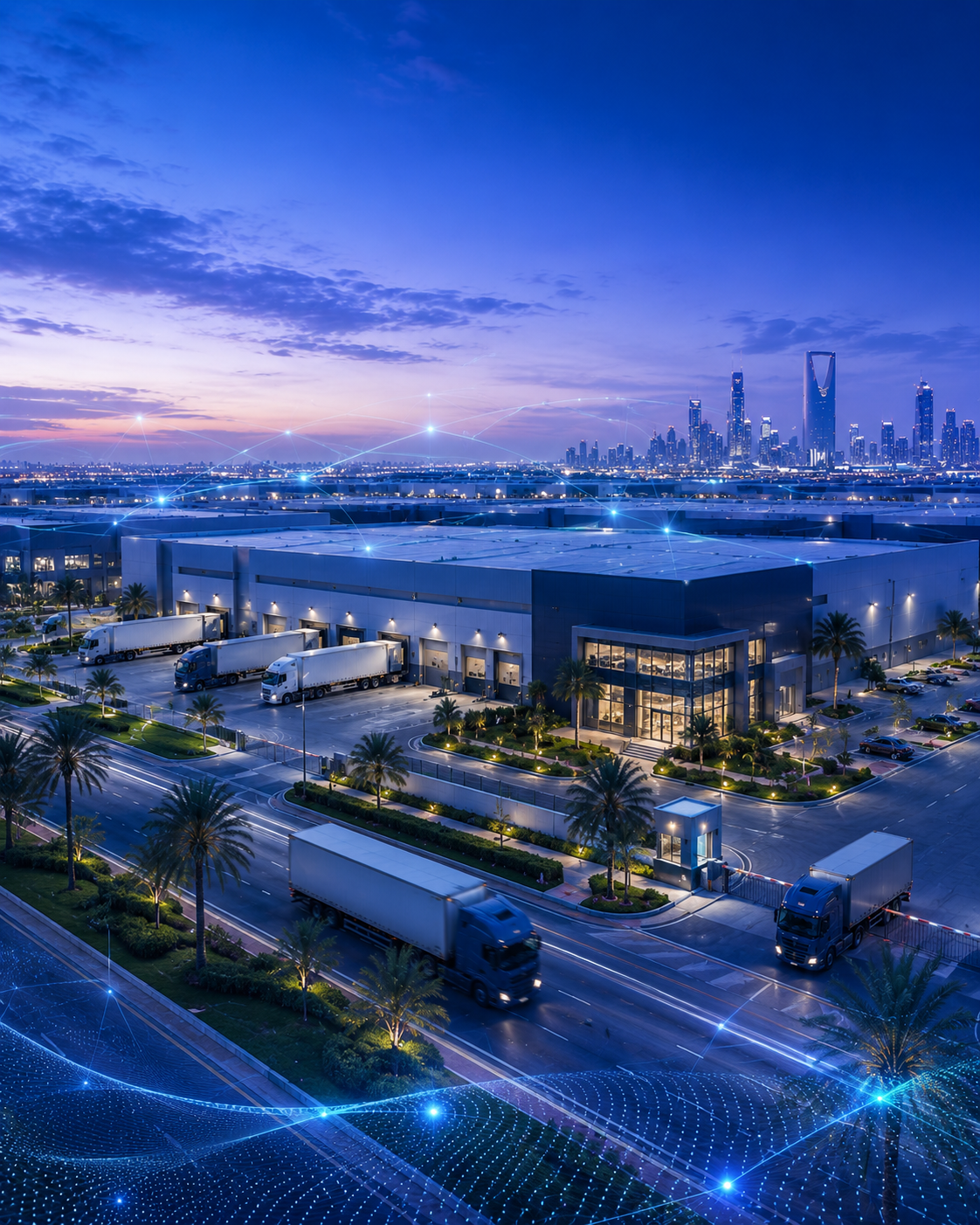
Taya Industrial City’s infrastructure is also being developed in line with the requirements of this transformation through fiber-optic networks and ultra-high-speed communications that support remote monitoring and management systems, sustainable energy supplies and continuous water and gas supplies serving production lines around the clock, and electrical and digital infrastructure prepared to accommodate the requirements of smart factories, sensing systems, and automation. The marketing idea here is that Taya Industrial City provides digital and electrical infrastructure prepared for the Fourth Industrial Revolution and smart factories, giving investors a foundation that is competitive today and capable of evolving with every coming wave of technology.
Taya Industrial City: Where Data Meets the Physical Location
The success of any previous investment calculation remains theoretical unless it is translated into actual land and infrastructure. Taya Industrial City extends across a total area of 3.6 million square meters and includes more than 728 investment opportunities distributed across six sectors, including 322 industrial plots allocated solely to light industries over an area exceeding 1.338 million square meters.
The location itself is part of the economic equation. Taya Industrial City is located on Al Kharj Road in Riyadh, providing direct access to the Kingdom’s largest consumer market, the city of Riyadh, and connections to transport networks serving a sector expected to grow from USD 25.33 billion in 2024 to USD 32.88 billion by 2029, at a compound annual growth rate of 5.36%. This means that every factory within Taya Industrial City benefits from the expansion of a transport ecosystem growing faster than the average growth of the economy itself. The city also provides warehouses and supporting commercial services within an interconnected operating environment, rather than leaving an isolated factory to manage its logistics independently.
In practical terms, the entry path passes through five consecutive stages. To enter Taya Industrial City, the investor identifies the industrial activity and estimates the required area according to the targeted production volume and expansion plans. The investor then selects the appropriate industrial plot, aligns the project’s technical requirements with the utilities and infrastructure, completes the regulatory licenses, and prepares the production lines in readiness for actual operations.
How Does Saudi Vision 2030 Support Investment in Light Industries?
Selecting a factory location begins with reading the state’s industrial directions and future plans. Accordingly, the National Industrial Development and Logistics Program, one of the largest Saudi Vision 2030 programs with investments exceeding USD 450 billion, focuses specifically on local content and the Fourth Industrial Revolution as two primary levers for achieving its objectives. The program specifically aims to increase the manufacturing sector’s contribution to GDP to 20% by developing capabilities in sectors including food manufacturing, pharmaceuticals, chemicals, and building materials, in addition to the defense and automotive sectors under the National Industrial Strategy. All of these are activities that fall directly under the umbrella of light industries hosted by Taya Industrial City. The program also aims to generate more than 219,000 new jobs and stimulate private-sector investments worth SAR 1.7 trillion by 2030.
From this perspective, investing in a light-industry factory within Taya Industrial City represents a commercial step that is simultaneously connected to the Kingdom’s industrial and development directions. It is supported by a national economic lever backed by sovereign investment figures and tangible localization targets, giving the early investor a stronger negotiating position before the current gaps between supply and demand reach saturation.
This timing, combining the maturity of the Kingdom’s industrial infrastructure, the widening of numerically documented sector gaps in packaging, medical supplies, and pharmaceuticals, and the accelerating wave of digital transformation within production lines, is what makes Taya Industrial City more than merely industrial land with strong specifications. It represents a calculated entry point into a sector that is currently redrawing the map of opportunities in the Saudi non-oil economy.
Begin Your Investment Journey with Taya Industrial City
If you are planning to invest in one of the light-industry sectors, selecting the location is one of the most important factors in the project’s success. Taya Industrial City provides developed industrial land, diverse investment opportunities, and integrated infrastructure supporting the establishment, operation, and expansion stages.
Explore the available investment opportunities or contact the Taya Industrial City team to select the solution that best suits your project.